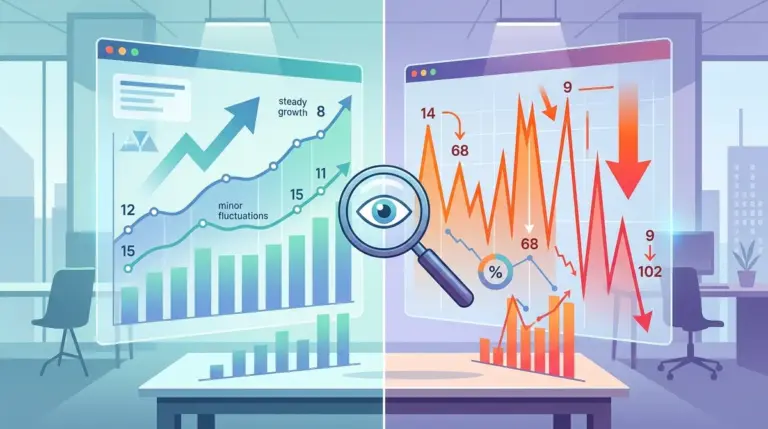
SEO reporting often triggers a state of high alert when a primary keyword drops from position three to position seven overnight. For agency account managers and in-house lead SEOs, this volatility is frequently interpreted as a failure of strategy or a technical regression. However, viewing every rank fluctuation as a problem is a strategic error that leads to reactive, short-term decision-making. In many cases, volatility is a byproduct of healthy search engine mechanics, competitive testing, or shifts in user intent that have nothing to do with a site’s technical integrity.
Distinguishing Between Algorithmic Testing and Site Penalties
Google does not maintain a static index. To determine the most relevant result for a specific query, the algorithm frequently "tests" different pages in higher positions to gather user signals like click-through rates (CTR) and dwell time. This is often referred to as the Google Dance. If your page drops several positions briefly and then returns, or if a new competitor suddenly spikes into the top five only to vanish two days later, you are witnessing an algorithmic experiment.
Best for: Identifying whether a drop is a site-wide issue or isolated volatility is to check the scope of the movement. If only 5% of your tracked keywords are fluctuating while the rest remain stable, it is almost certainly a localized test rather than a penalty or a broad algorithm update.
The Impact of Query Deserves Freshness (QDF)
Certain keywords are susceptible to "Query Deserves Freshness" triggers. When a topic suddenly becomes news-heavy or trends on social media, Google prioritizes recent content over historically authoritative content. For example, a guide on "remote work tools" might see volatility when a major tech company announces a massive return-to-office policy. News outlets and blogs will temporarily displace evergreen guides. This is not a sign that your evergreen content has lost value; it is a temporary shift in the SERP's intent profile to favor "fresh" results.
- Temporary Displacement: News carousels and "Top Stories" pushing organic results down.
- Intent Shift: Users searching for a term might suddenly want news rather than a tutorial.
- Recovery: Evergreen content typically regains its position once the news cycle stabilizes.
SERP Feature Expansion and Real Estate Loss
Sometimes your "rank" in a tracking tool stays the same, but your traffic drops, or your rank fluctuates because Google is changing the layout of the results page. The introduction of an AI Overview, a larger People Also Ask (PAA) block, or a local map pack can push the first organic result significantly further down the fold. In these instances, the volatility in your tracking software reflects Google’s internal testing of SERP features rather than a judgment on your content quality.
Pro Tip: Always cross-reference rank volatility with "Pixel Height" or "Top of Fold" metrics. A keyword that drops from position 1 to 2 because of a new sponsored shopping carousel requires a different response than a drop caused by a competitor’s superior content.
Competitive Content Refresh Cycles
Volatility is often a sign of a healthy, competitive niche. When a competitor updates a long-form guide with new data, images, or expert quotes, Google may give them a temporary "re-indexing boost" to see how users respond to the new version. This can cause your rankings to jitter. If you see a competitor leapfrog you, the correct response is not immediate panic, but a gap analysis. Are they providing a more recent data point? Is their page speed significantly better on the updated URL? Often, these shifts are temporary as the algorithm settles after the initial re-crawl.
Technical Volatility vs. Ranking Volatility
It is critical to separate ranking shifts caused by the algorithm from those caused by your own site’s technical infrastructure. If volatility is accompanied by a spike in 404 errors or 5xx server errors in Search Console, then you have a genuine problem. However, if your technical health scores remain high and your Core Web Vitals are stable, the volatility is external. External volatility is usually market-driven and should be monitored for at least 72 hours before any tactical changes are implemented.
Developing a 72-Hour Response Protocol
Instead of reacting to daily rank changes, implement a cooling-off period. Most minor algorithmic tests resolve within three to five days. During this window, your primary task is data collection, not content revision. Changing a title tag or moving internal links in the middle of a Google "test" can muddy the data and make it impossible to determine what actually caused the eventual rank stabilization.
Focus on the following steps during a period of high volatility:
- Check Search Console: Ensure there are no manual actions or critical crawl errors.
- Analyze the SERP: Look for new features like AI Overviews or Video carousels that might be displacing organic links.
- Monitor Competitors: See if the volatility is affecting everyone in your niche or just your domain.
- Verify Intent: Determine if the search results have shifted from "informational" to "transactional."
By treating volatility as a data point rather than a crisis, SEOs can maintain a more stable long-term strategy and avoid the "over-optimization" trap where constant tweaking prevents a page from ever reaching its full potential in the index.
Frequently Asked Questions
How long should I wait before reacting to a ranking drop?
Standard industry practice is to wait 3 to 7 days. This allows for "SERP churn" to settle and for Google to complete any localized testing or small-scale algorithm tweaks.
Can high volatility actually be a good sign?
Yes. If you have recently optimized a page and see it jumping in and out of the top 10, it often means Google is testing your new content against established leaders. This "testing phase" is a necessary precursor to a permanent move into a higher position.
What is the difference between churn and a trend?
Churn is characterized by rapid, non-linear movement (up 3, down 5, up 2). A trend is a consistent, directional move over several weeks. You should only change your strategy based on trends, not churn.
Does every algorithm update cause volatility?
Major core updates always cause volatility, but Google also pushes hundreds of smaller updates annually that may only affect specific industries or types of queries. Not all volatility is tied to a named update.