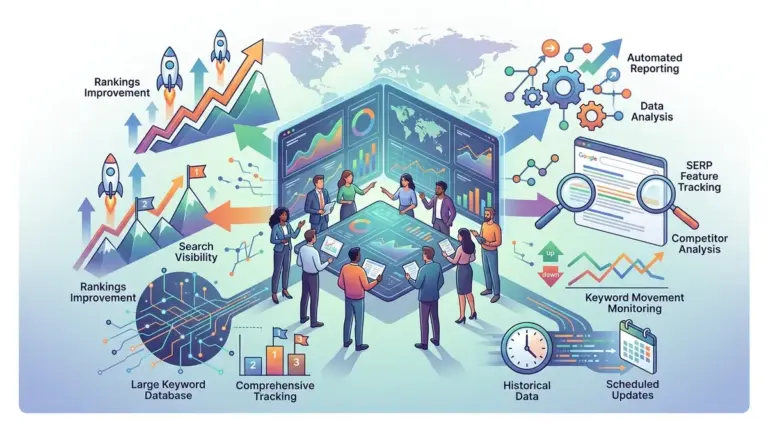
Selecting a keyword ranking tracker is rarely about finding the tool with the most features; it is about finding the one that provides the most reliable data for your specific business model. For an agency managing fifty local service clients, the requirements differ vastly from an enterprise SEO overseeing a global e-commerce site with a million SKUs. High-velocity SEO requires data that reflects the current state of the SERP, not a cached version from forty-eight hours ago. When the difference between position two and position four can result in a 30% drop in click-through rate, the latency and accuracy of your tracking tool become your most significant competitive advantages.
Data Latency and Refresh Frequency
The most common failure in rank tracking is stale data. Most entry-level tools update rankings once every 24 hours. While this is acceptable for low-competition niches, it is insufficient for news publishers, high-volatility retail sectors, or during major Google algorithm updates. You need to identify whether a tool offers on-demand refreshes or "instant" updates. This allows you to verify the impact of a site deployment or a content optimization in real-time rather than waiting for a scheduled crawl.
Best for: Sites in volatile niches or agencies that need to provide immediate proof of work after a technical fix.
Granular Localization and Device Segmentation
Google no longer serves a single "national" SERP. Results are heavily influenced by the user's IP address, GPS coordinates, and device type. A tracker that only provides "United States - Desktop" data is missing the reality of the mobile-first index. Look for tools that allow you to track at the city, zip code, or even neighborhood level. This is non-negotiable for local SEO. Furthermore, the tool must distinguish between mobile and desktop rankings, as the layout of SERP features like "People Also Ask" and "Local Packs" varies significantly between devices, directly impacting your organic real estate.
Warning: Avoid trackers that use "proxy-based" location spoofing without verifying the results against real-user agents. If a tool cannot simulate a specific mobile device type (e.g., iPhone 15 vs. Samsung Galaxy), the ranking data for local packs and image carousels will likely be inaccurate.
SERP Feature Tracking Beyond Blue Links
Ranking #1 for a traditional blue link is often less valuable than appearing in a Featured Snippet or a Local Map Pack. Modern rank tracking must account for the "visual rank" or "pixel height" of a result. If your keyword has a massive AI Overview or four sponsored ads at the top, your #1 organic position might be "below the fold."
- Featured Snippets: Does the tool track if you own the snippet or if a competitor has stolen it?
- People Also Ask (PAA): Can the tool identify which questions your pages are answering?
- Local Packs: Does it track your position within the "Map Pack" specifically?
- Video and Image Carousels: Essential for lifestyle, DIY, and recipe niches.
A sophisticated tracker will provide a "Share of Voice" metric that weights your rankings based on search volume and the presence of these SERP features, giving you a more realistic view of your actual traffic potential than a simple average position.
Competitor Benchmarking and Historical Context
Raw ranking numbers are meaningless without context. You need to see how your competitors are moving in the same space. A high-quality tracker should allow you to add "shadow" competitors—domains you don't own but want to monitor alongside your own. This reveals whether a drop in your rankings is a site-specific issue or a broader industry trend caused by an algorithm shift. Furthermore, look for tools that store historical data indefinitely. Being able to compare your current performance to the same period last year is vital for seasonal businesses and for reporting year-over-year growth to stakeholders.
Scalability, API Access, and Integration
For agencies and large-scale publishers, the user interface is often less important than the tool's ability to export data. If you are managing thousands of keywords, manually checking a dashboard is inefficient. You need a tool that integrates seamlessly with Looker Studio (formerly Google Data Studio), Google Sheets, or has a robust API.
Best for: Enterprise teams that need to merge ranking data with conversion data from GA4 or CRM systems to calculate the actual ROI of specific keyword clusters.
Pricing models also dictate scalability. Some tools charge per keyword, while others charge per "update." If you track 1,000 keywords and update them daily, that is 30,000 updates a month. Ensure the pricing structure aligns with your refresh needs so you don't face unexpected overage charges during high-traffic periods.
Tagging and Keyword Categorization
Reporting on 5,000 keywords as a single bucket is unhelpful. You need to be able to tag keywords by intent (informational, transactional), product category, or campaign phase. This allows you to see, for example, that while your overall average position is dropping, your "high-intent" commercial keywords are actually gaining ground. Robust tagging systems enable you to filter reports instantly and identify which specific areas of a site require immediate attention.
Auditing Your Current Tracking Requirements
Before committing to a long-term contract, run a pilot with a subset of your most important keywords. Compare the tool's reported rankings against a manual "incognito" search from the relevant location. If the discrepancies are frequent, the tool's proxy network is likely failing. Prioritize data integrity and the ability to segment that data over flashy visualizations. A tracker is a diagnostic tool, not a presentation slide; its primary job is to alert you to shifts in the search landscape before they result in a permanent loss of revenue.
Frequently Asked Questions
How often should I refresh my keyword rankings?
For most businesses, a daily update is the standard. However, if you are in a fast-moving industry like finance, news, or high-competition e-commerce, you may need on-demand refreshes to track the immediate impact of site changes or market shifts.
Why does my tracker show a different position than my manual search?
This is usually due to personalization, IP-based localization, or data centers. Google serves different results based on your search history and physical location. A professional tracker uses clean proxies to simulate a "neutral" user, which is often more accurate for broad SEO reporting than a localized manual search.
What is the difference between keyword-based and credit-based pricing?
Keyword-based pricing typically allows you to track a set number of terms with a fixed refresh rate (e.g., 500 keywords updated daily). Credit-based pricing gives you a pool of "checks" that you can spend however you like—tracking more keywords less often, or fewer keywords multiple times a day.
Is mobile rank tracking really different from desktop?
Yes. Google uses mobile-first indexing, and the SERP layout on mobile devices often includes more local features, shorter snippets, and different ad placements. Tracking both is essential to understand your total search visibility.