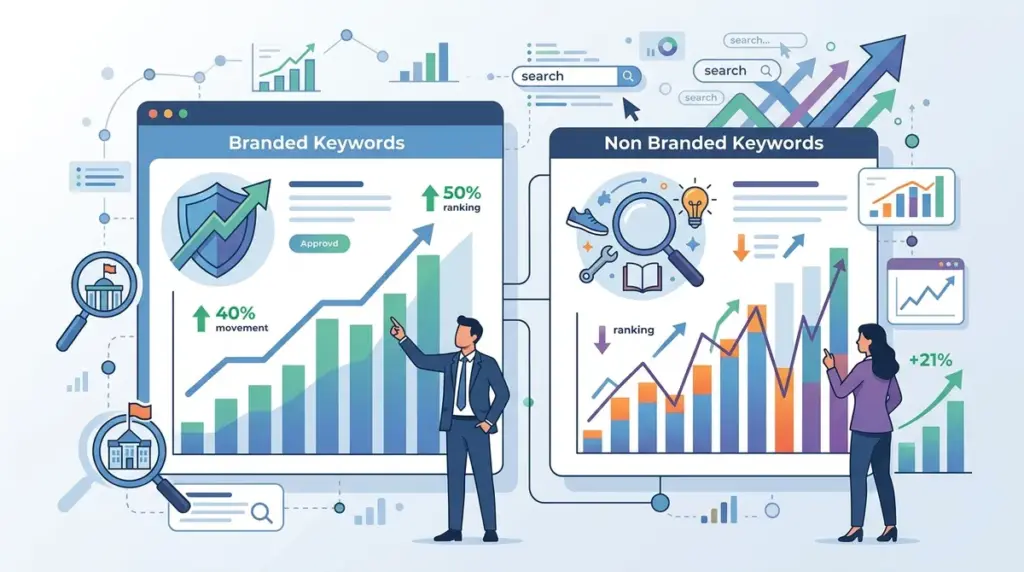
Search visibility is a zero-sum game where the distinction between branded and non-branded traffic determines your cost per acquisition and long-term market share. Branded keywords act as a defensive perimeter, ensuring customers who already know your name find the correct landing page without being diverted by competitors. Non-branded keywords represent your offensive strategy, capturing users at the top and middle of the funnel who are searching for solutions rather than specific companies. To scale a digital presence, you must track both, but the KPIs you apply to each must be fundamentally different. Effectively scaling your digital presence depends on how to pick the best keywords for each stage of the funnel.
The Mechanics of Branded Keyword Defense
Branded keywords include your company name, specific product names, and variations involving your brand plus modifiers like "login," "pricing," or "reviews." While many marketers assume they will naturally rank first for their own name, this is a dangerous oversight. Competitors frequently bid on your brand terms in Google Ads, pushing your organic #1 result below the fold. Tracking these terms allows you to monitor "Share of Voice" and identify when a competitor is aggressively poaching your existing customer base.
Primary Goal: Retention and reputation management. You are looking for 100% visibility and high Click-Through Rates (CTR), often exceeding 30-50% for the top spot.
Tracking branded terms also provides a health check for your technical SEO. If a "Brand + Support" search leads to a deprecated blog post instead of your help center, your internal linking or site structure is failing. Monitoring these specific variations ensures that the user journey remains frictionless for your most valuable, high-intent users.
Scaling Market Share via Non-Branded Intent
Non-branded keywords are the lifeblood of new customer acquisition. These are the "category" terms—such as "enterprise project management software" or "best hiking boots"—that users search for when they have a problem but haven't settled on a provider. Because these terms are highly competitive, your ranking directly correlates to your growth potential within the industry.
When tracking non-branded keywords, focus on intent-based clusters:
- Informational: "How to calculate ROI for SaaS." These build authority and top-of-funnel awareness.
- Commercial Investigation: "Top 10 CRM platforms for small business." These are users comparing options.
- Transactional: "Buy organic coffee beans online." These are high-conversion terms that require aggressive tracking and optimization.
Primary Goal: Acquisition and brand discovery. Success here is measured by incremental movement in rankings and an increase in total organic impressions across a broad set of terms.
Warning: Ignoring non-branded tracking leads to "Brand Decay." If you only track your brand name, your dashboard may show stable rankings while your competitors are actually capturing 90% of the new market demand by dominating the category terms you’ve neglected. To avoid this market decay, focus on prioritizing high-value keywords that capture new demand.
Divergent Metrics: How to Measure Success
You cannot use the same benchmarks for both categories. A 5% CTR on a non-branded term in position three might be an elite performance, whereas a 5% CTR on your own brand name indicates a catastrophic loss of traffic to competitors or poor SERP features.
Conversion Rates: Branded traffic almost always converts at a higher rate because the user has already bypassed the "awareness" stage. Expecting non-branded traffic to match these conversion rates will lead to skewed ROI projections. Instead, measure non-branded success by "Assisted Conversions" or how many users enter the funnel through a non-branded search and eventually return via a branded search.
Volatility: Branded rankings should be static. If your brand terms drop even one or two positions, it usually signals a technical penalty, a site migration error, or a significant surge in "negative SEO" from a competitor. Non-branded rankings, however, are subject to the daily fluctuations of core algorithm updates and competitor content refreshes. Frequent movement here is normal and requires a long-term trend analysis rather than a knee-jerk reaction to a single day's data.
Segmenting Your Rank Tracking Dashboard
To gain actionable insights, your tracking environment must be segmented. Mixing these two types of keywords into a single "Average Position" metric creates a useless data point. If your brand terms rank #1 and your non-branded terms rank #50, an average of #25 tells you nothing about the health of either strategy.
Best Practice: Use tags or folders to separate "Core Brand," "Product Names," "Category Terms," and "Competitor Terms." This allows you to report on "Category Share of Voice" independently of brand strength. For agencies, this distinction is vital for proving value; it allows you to show that while brand traffic may be flat, you have increased non-branded visibility by 40%, which is where the real growth resides.
Identifying Keyword Cannibalization and SERP Overlap
Sometimes the line blurs. If you have a specific product name that is also a common noun (e.g., "Flow" or "Spark"), you face a unique challenge. You are essentially competing in a non-branded space for your own brand name. Tracking these requires looking at "Search Intent." Does Google see the term as a brand or a generic concept? If the SERP is filled with dictionary definitions and competitors, you must treat that branded term with the same aggressive content strategy used for non-branded acquisition.
Furthermore, monitor for "Internal Cannibalization." This occurs when your non-branded blog posts begin outranking your branded product pages for high-intent terms. While you still own the traffic, you may be sending users to a "Top 10" list instead of a "Buy Now" page, inadvertently lowering your conversion rate. Tracking both categories in the same tool allows you to see which specific URL is winning the rank and adjust your internal linking to guide the user correctly.
Establishing a Dual-Track Monitoring Routine
To manage these effectively, adopt a tiered monitoring schedule. Branded terms should be monitored daily with automated alerts for any drop out of the top three positions. These are "fire drills" that require immediate investigation. Non-branded terms can be analyzed on a weekly or bi-weekly basis, focusing on clusters and movements within the top 10 or top 30 results.
Focus your optimization efforts on "Striking Distance" non-branded keywords—those currently ranking in positions 4 through 11. Moving a non-branded category term from page two to the middle of page one often results in a more significant revenue lift than moving a branded term from position two to position one.
Frequently Asked Questions
Should I track my competitors' branded keywords?
Yes. Tracking competitor names allows you to see if they are gaining traction or if Google is starting to associate your site with their brand in "People Also Search For" boxes. It also helps you identify "Comparison" or "Alternative to" content opportunities where you can capture their dissatisfied users.
Why is my non-branded traffic increasing while my revenue stays flat?
This usually indicates a mismatch between keyword intent and landing page content. You may be ranking for "Informational" terms that attract researchers rather than buyers. To fix this, shift your tracking focus toward "Commercial" or "Transactional" non-branded terms that align closer to the point of purchase.
How many branded vs. non-branded keywords should I track?
For most businesses, the ratio should be roughly 10% branded and 90% non-branded. You only have a finite number of brand variations, but the ways people can search for your solutions are nearly infinite. Most of your growth will come from identifying and winning new non-branded niches.
Does tracking branded keywords help with PPC costs?
Absolutely. By monitoring your organic branded strength, you can identify terms where you have total dominance and potentially reduce your PPC spend on those terms. Conversely, if you see a competitor bidding on your brand and taking the top spot, you know you must increase your defensive ad spend to protect that traffic.