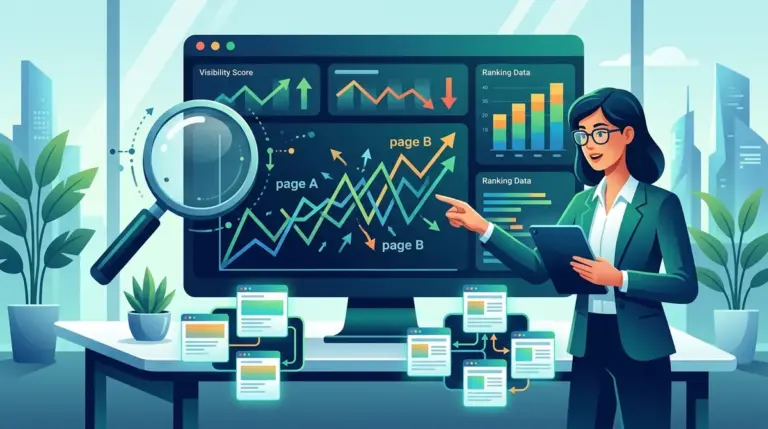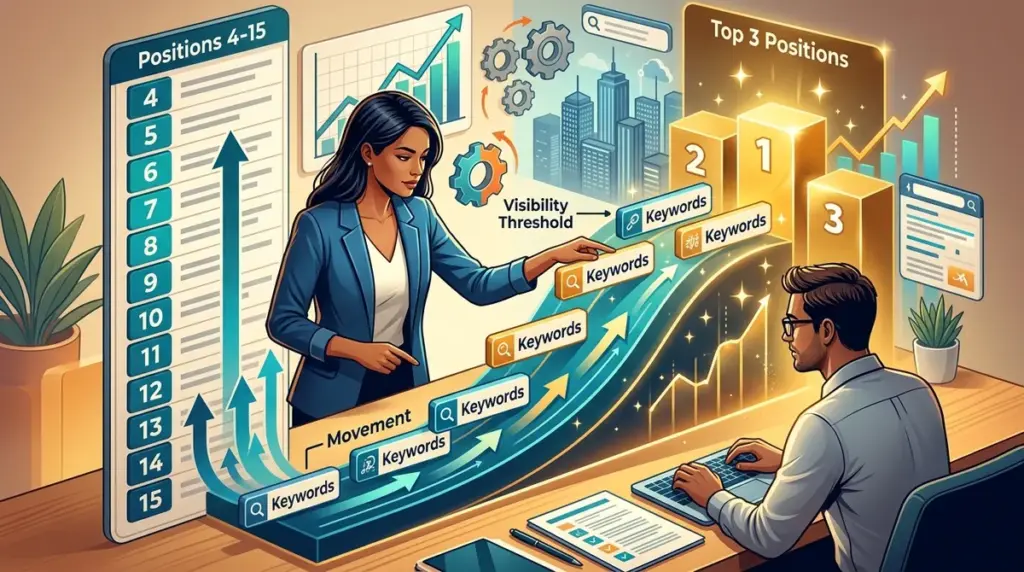
Keywords sitting in positions 4 through 15 represent the highest immediate ROI in any SEO campaign. These are "striking distance" terms—pages that Google already deems relevant and authoritative enough to rank on the first or top of the second page, but which are failing to capture the lion's share of traffic. Moving a keyword from position 8 to position 2 can result in a 300% to 500% increase in click-through rate (CTR) without the need to launch new content or build dozens of new top-level landing pages.
The strategy for these keywords differs from ranking new content. You are no longer trying to prove relevance from scratch; you are trying to prove superiority over the three to five results currently outperforming you. This requires a surgical approach to content depth, internal link equity, and user experience signals.
Audit Content Depth Against the Top Three
If a page is stuck at position 6, it usually means the content is "good enough" but lacks the specific entity density or utility found in the top three results. Do not simply add word count. Instead, perform a gap analysis on the entities and subtopics covered by the leaders.
Identifying Information Gaps
Analyze the top three ranking URLs for your target keyword. Look for specific sections, data points, or interactive elements you have omitted. For example, if the top results include a "cost calculator" or a "comparison table" and your page is purely text-based, that is a functional gap. Use NLP tools to identify missing semantic keywords—terms that Google expects to see in a comprehensive guide on the subject. If you are ranking for "best CRM for real estate" but fail to mention "lead routing" or "IDX integration," your topical authority is capped.
Aggressive Internal Linking from High-Authority URLs
Internal linking is the most controllable lever for pushing keywords from page two to the top of page one. Most sites have a handful of "power pages" that have accumulated significant external backlink equity. You must funnel that equity to your striking distance pages.
- Identify Donor Pages: Use your ranking tracker or a backlink audit tool to find your pages with the highest URL Rating (UR) or Page Authority.
- Exact Match Anchors: Unlike external backlinks, where over-optimization can trigger penalties, you can be more aggressive with internal anchor text. Use the exact keyword you are trying to rank for.
- Contextual Placement: Place the link high up in the body copy of the donor page. Links in the first 200 words typically pass more value than footer or sidebar links.
- Remove Dilution: Audit the striking distance page for outgoing links. If you are sending too much "link juice" away to low-value pages, you are weakening the page's ability to rank.
Pro Tip: Check for "Search Intent Drift." Google frequently updates its understanding of intent. If your position 4-15 page was written as a long-form guide but the top 3 results are now "top 10" lists or product category pages, no amount of backlinking will move you up. You must pivot the format to match the current SERP intent.
Optimize for the "Long Click" and User Experience
Google monitors how users interact with search results to determine if a page deserves a promotion. If users click your result at position 9, stay for four minutes, and never return to the SERP, that is a "long click"—a signal of high satisfaction. If they bounce back in five seconds, you will stay stuck or drop.
Improve Readability and Interaction
Break up walls of text. Use H3 tags to make the page skimmable. Ensure your "Time to First Byte" (TTFB) is under 200ms. If a user has to wait three seconds for your page to load, they will bounce before they even read your headline. Add "Jump Links" (a table of contents) at the top of the page. This not only improves UX but can also generate "jump to section" snippets in the SERP, increasing your vertical footprint and CTR.
The CTR Lever: Winning the Click at Position 7
If your CTR is significantly higher than the average for your current position, Google's algorithm may test your page in a higher slot. You are essentially auditioning for the top spot. Your title tag and meta description are your primary sales tools here.
Best for: Increasing traffic without changing rankings. Use brackets in your title tags, such as [2024 Study] or [Template Included], to differentiate your result from the standard headlines. If the top three results are all "How to" guides, try a "Why You Are Failing at..." headline to capture the contrarian click. This psychological shift can improve CTR enough to trigger a ranking boost.
Execute a Technical Refresh
Sometimes a page is held back by technical debt that doesn't affect the whole site but impacts specific URLs. Check the striking distance page for:
1. Schema Markup: Ensure FAQ, Product, or Review schema is correctly implemented to win rich snippets.
2. Image Optimization: Large, uncompressed images can kill mobile performance, which is a primary ranking factor.
3. Mobile Parity: Ensure that the content visible on desktop is also fully visible and functional on mobile. Google uses mobile-first indexing; if your "striking distance" content is hidden behind "read more" buttons on mobile, it may not be weighted fully.
Accelerating Movement with Freshness Signals
Google favors fresh content for many queries. A simple update to the "Last Updated" date isn't enough. You need to actually change the content. Add a new paragraph discussing a recent industry trend, update old statistics, or add a new video embed. When Google recrawls the page and sees a significant percentage of the HTML has changed, it re-evaluates the page's position in the index.
Next Steps for Striking Distance Keywords
To move the needle, stop treating these pages as "finished." Create a dedicated sprint for keywords in positions 4-15. Start by updating the metadata for CTR, then add 2-3 internal links from your highest-authority pages. Finally, perform a content gap analysis to ensure you aren't missing the specific entities that the top three results possess. Monitor your ranking tracker daily during this process; movement usually occurs within 7 to 14 days of a significant internal link or content update.
Frequently Asked Questions
How long does it take to see rankings improve for striking distance keywords?
If the improvement is driven by internal linking or content refreshes, you can see movement in as little as one week. If the gap is due to a lack of external backlinks, it may take 30 to 60 days for new authority signals to be processed and reflected in your position.
Should I change the URL of a page in position 12 to make it more SEO-friendly?
No. Changing the URL triggers a redirect, which can cause a temporary loss of "link juice" and force Google to re-evaluate the page from scratch. Only change the URL if it is fundamentally broken or misleading. Focus on on-page content and internal links instead.
Is it better to focus on position 4-10 or position 11-20?
Focus on 4-10 first. These pages are already on the first page, meaning they have passed the most significant quality thresholds. The effort required to move from 7 to 3 is often less than the effort required to move from 15 to 9, and the traffic reward is significantly higher.
What if my page is stuck at position 5 despite having better content and more links?
Check for SERP features. Sometimes the top 3 spots are taken by "People Also Ask" boxes, local maps, or shopping carousels. In these cases, you aren't just competing with other URLs; you are competing with Google's own features. You may need to optimize for Featured Snippets or Schema to bypass the traditional blue links.