A ranking report that only tracks integer positions is a liability. For years, the SEO industry relied on a simple correlation: higher rankings equaled more traffic. That relationship has fractured. With over 50% of Google searches now ending without a click to a non-Google property, a "Position 1" result no longer guarantees a visit. For agencies and in-house marketers, this shift requires a total overhaul of how keyword performance is communicated to stakeholders.
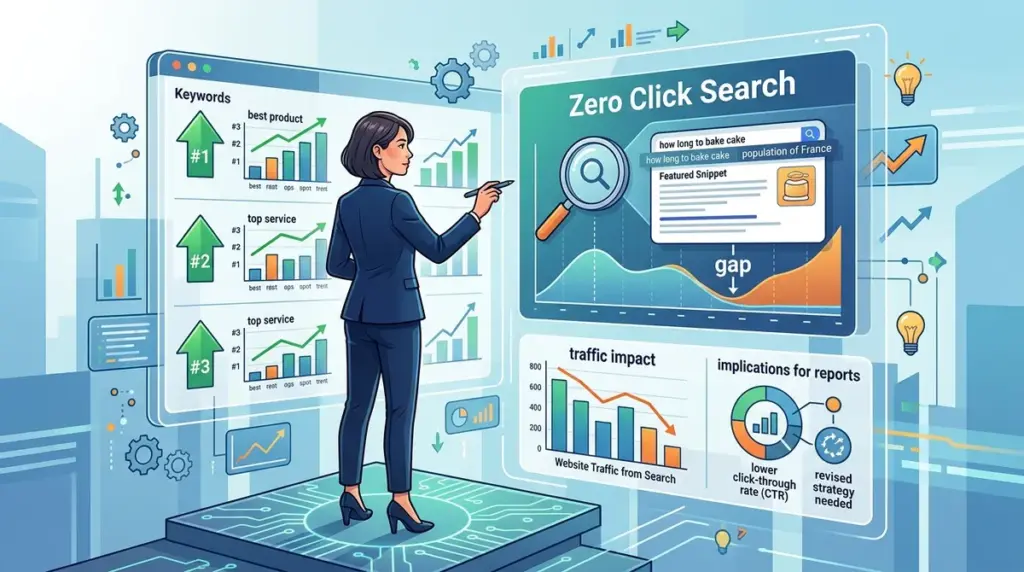
Zero-click searches occur when Google satisfies a user’s intent directly on the Search Engine Results Page (SERP). Whether through a Featured Snippet, a Knowledge Panel, or a Local Pack, the user gets their answer and leaves. If your reporting doesn't account for these features, you are likely presenting a distorted view of your SEO ROI. You might see rankings climbing while organic sessions stagnate, leading to difficult conversations with clients who don't understand the disconnect.
The Disconnect Between Position One and Organic Traffic
The traditional "Top 10" list is becoming an abstract metric. In a zero-click environment, the layout of the SERP determines the value of a ranking more than the rank itself. For example, a ranking for a high-volume informational keyword like "how to calculate ROI" might be technically in position one, but if a Featured Snippet occupies 600 pixels of vertical space above it, the actual click-through rate (CTR) for that top organic result will plummet. Understanding the exact impact of these changes requires a close look at how AI overviews impact rankings and visibility.
Metric to Watch: SERP Real Estate Percentage. Instead of just tracking position, modern reports should estimate the "pixel depth" of the first organic result. If your keyword is buried below a "People Also Ask" block and a sponsored carousel, its commercial value is significantly lower than a position three ranking on a "clean" SERP.
Featured Snippets and the 'Answer Engine' Shift
Featured Snippets are the primary drivers of zero-click behavior for informational queries. When Google extracts a paragraph or list from a site to answer a query, it provides immediate utility but removes the incentive to click. However, being the source of that snippet still holds brand value. Reporting must differentiate between "Ranking with Snippet Ownership" and "Ranking below a Competitor’s Snippet."
Knowledge Panels and Local Pack Dominance
For branded and local searches, the Knowledge Panel and Local 3-Pack act as massive click-sinks. If a user searches for a business name to find a phone number or hours, they will find it in the panel and never visit the site. In these cases, "impressions" and "conversions" (like phone calls or direction requests) become more important than "clicks" or "rankings."
Modernizing the Ranking Report: Metrics That Actually Matter
To stay relevant, keyword ranking reports must move away from static lists and toward a "Share of Voice" model. This involves weighing rankings based on the presence of distracting SERP features. A position two ranking on a page with zero ads and no snippets is often more valuable than a position one ranking on a page crowded with Google-owned modules. This shift necessitates a new approach to reporting, focusing on how AI overviews are changing tracking methods.
- SERP Feature Ownership: Track how many Featured Snippets, Image Packs, and Video Carousels your domain currently occupies.
- Adjusted CTR Projections: Apply a discount to traffic estimates for keywords where Google provides direct answers.
- Pixel Height: Measure how far down the page the first organic result appears. This is a direct indicator of "above the fold" visibility.
- Brand Impression Value: Quantify the value of appearing in a Knowledge Panel or Snippet even when a click doesn't occur, treating it as a digital billboard.
Warning: Don't mistake a drop in organic traffic for a failure in SEO strategy if your "Position 1" rankings are stable. Often, this indicates that Google has introduced a new SERP feature that is cannibalizing the clicks for that specific intent.
Strategic Pivot: Targeting 'Long-Click' Keywords
As zero-click searches dominate short, factual queries, the commercial focus must shift toward "long-click" keywords. These are queries that require deep exploration, comparison, or interaction—tasks Google’s AI cannot yet satisfy on the SERP. Ranking reports should categorize keywords by "Click Potential" to help prioritize content efforts.
Best for: B2B and high-ticket service providers. Focus on "How-to" guides that require multi-step instructions or "Best of" comparisons where the user needs to evaluate multiple sources. These intents are naturally resistant to zero-click behavior because the user's need is too complex for a 50-word snippet.
When reporting to clients, highlight the growth in these high-intent, high-click-potential areas. This demonstrates that you are not just chasing "vanity rankings" but are securing placements that actually drive pipeline and revenue.
Implementing a Zero-Click Reporting Strategy
To adapt your reporting, start by segmenting your keyword lists by SERP layout. Use a rank tracker that identifies which features are present for every tracked term. If a keyword is consistently producing zero-click results, evaluate whether it is worth the effort to maintain that ranking or if resources should be reallocated to "un-snipettable" queries.
Your goal is to move the conversation from "Where do we rank?" to "How much of the searcher's attention do we own?" This requires a more nuanced data set, but it protects the agency's credibility by aligning SEO performance with the actual traffic reality of the modern web. Stop reporting on the SERP as it existed five years ago and start reporting on the pixel-dense, feature-heavy environment that exists today.
Frequently Asked Questions
How do I explain a traffic drop to a client when rankings haven't changed?
Use a SERP comparison tool to show the client that Google has added new features—like a "People Also Ask" block or a larger Featured Snippet—above your organic result. Explain that while your "rank" is the same, your "visibility" has been pushed down the page by Google's own interface changes.
Should I stop trying to rank for keywords that have a Featured Snippet?
No, but you should change your goal. If you don't own the snippet, your competitor will. Owning the snippet gives you brand authority and prevents a competitor from capturing that "Position Zero" real estate. However, do not expect high click-through rates from these terms; treat them as brand awareness plays.
What is the most important metric to replace Average Position?
"Share of Voice" or "Estimated Organic Clicks" are better alternatives. These metrics take the raw ranking and weight it against the estimated CTR of that specific SERP layout, providing a much more accurate prediction of actual business value.