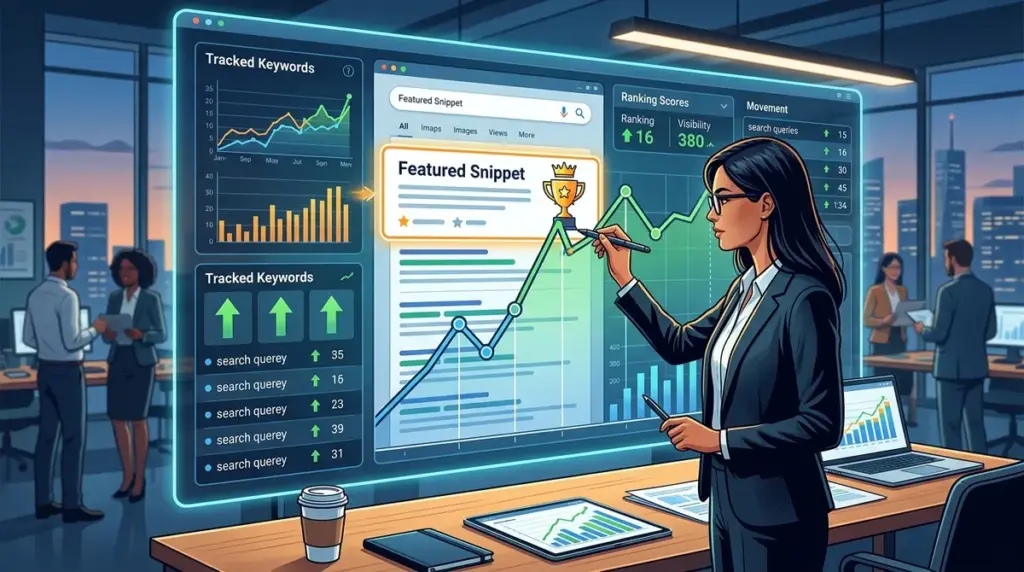
Securing a featured snippet is no longer just a "bonus" for SEO visibility; it is a fundamental shift in how organic traffic is distributed. Since Google’s 2020 deduplication update, a URL that wins the snippet is removed from the standard organic listings on the first page. This means tracking "Position Zero" requires a different methodology than traditional rank tracking. If you are only monitoring your numerical rank, you are missing the context of whether you are actually dominating the SERP or losing clicks to a competitor’s expanded answer box.
The Impact of Deduplication on Rank Tracking Strategy
Before 2020, a site could hold both the featured snippet and the #1 organic spot. Today, the snippet is the first organic result, but it functions differently. When you track these rankings, your software must distinguish between a standard blue link at position one and a featured snippet. A standard #1 ranking might yield a 25% click-through rate, but a featured snippet—depending on the query type—can either skyrocket that CTR or cannibalize it if the answer is fully contained within the box.
Best for: Identifying high-intent queries where "zero-click" behavior is prevalent, allowing you to pivot content strategy toward more complex topics that require a full click.
Categorizing Snippet Types for Precise Monitoring
Not all snippets are created equal, and your tracking data should reflect the specific format Google is pulling from your page. Tracking the "type" of snippet helps you understand how Google perceives your content structure. Monitoring these variations allows you to adjust your HTML markup accordingly.
- Paragraph Snippets: Usually triggered by "why" or "what is" queries. Monitoring these tells you if your introductory definitions are concise enough.
- List Snippets (Numbered/Bulleted): Common for "how-to" guides or "best of" rankings. Tracking these indicates if your H3 headers are logically sequenced.
- Table Snippets: Often appearing for data comparisons or pricing. If you lose a table snippet, it usually means a competitor has provided a more structured data set.
- Video Snippets: Increasingly common for tactical tutorials. Tracking these requires monitoring YouTube rankings alongside your core domain.
Configuring Filtered Views for SERP Features
To manage featured snippets at scale, you cannot rely on manual checks. You need to configure your rank tracking dashboard to isolate keywords that contain SERP features. Most professional-grade trackers allow you to filter by "Featured Snippet" presence. You should set up two specific views: "Keywords with Snippets Owned" and "Keywords with Snippets Owned by Competitors."
By isolating the keywords where a competitor owns the snippet but you rank in positions 2 through 5, you create a "strike list." These are your highest-priority targets for content optimization because you are already on the first page; you simply need to better format your answer to "steal" the snippet.
Pro Tip: Monitor the "flicker" rate. If you see a keyword frequently jumping between the snippet and position 4, Google is testing the relevance of your answer against another source. This is a signal to update your data or improve the readability of your "answer paragraph."
Analyzing Mobile vs. Desktop Snippet Discrepancies
Snippet ownership is not universal across devices. Because of the limited screen real estate on mobile, Google often selects shorter, more concise snippets for smartphone users compared to desktop users. If your tracking data shows you own the snippet on desktop but are relegated to position 2 on mobile, your content may be too verbose for mobile-first indexing.
Effective tracking requires a dual-device approach. You must track the same keyword set across both mobile and desktop to ensure your "Position Zero" dominance is consistent. If you notice a gap, look at your page load speed and the "above the fold" placement of your primary answer. Mobile snippets favor fast-loading pages where the answer is easily accessible without excessive scrolling.
Measuring the Share of Voice in Featured Snippets
For agencies and enterprise SEOs, reporting on individual keyword ranks is often less useful than reporting on "Share of Voice" (SoV). When you track featured snippets, you should calculate your "Snippet SoV." This is the percentage of available snippets you own within a specific keyword category.
If your SoV is dropping while your average position remains stable, it indicates that Google is introducing more SERP features that you are failing to capture. This is a leading indicator of a future traffic decline, even if your "rankings" look healthy on paper. Tracking the total pixel height of your snippets can also provide a metric for how much "SERP real estate" you are occupying compared to competitors.
Technical Optimization Based on Tracking Data
Once your tracking identifies a snippet opportunity where you rank in the top 5 but don't own the box, use the data to drive these specific technical edits:
The 40-60 Word Rule: Paragraph snippets usually pull around 45 words. If your tracking shows you aren't winning the box, check if your target "answer" paragraph is significantly longer or shorter than this range.
Header Proximity: Google often pulls a snippet from the text immediately following an H2 or H3 that matches the user's query. Ensure your tracking tool identifies which specific header is triggering the snippet for your competitors.
Turning Snippet Data into Actionable Content Updates
Tracking is only as valuable as the execution it triggers. Use your "Snippets Lost" report to schedule monthly content refreshes. Focus on the keywords with the highest search volume first. Often, regaining a lost snippet is as simple as updating a date in a table or reformatting a list from a paragraph into a proper <ul> or <ol> structure. By treating featured snippets as a volatile asset that requires constant monitoring, you protect your highest-converting traffic from aggressive competitor poaching.
Featured Snippet Tracking FAQ
Does a featured snippet always increase click-through rate?
Not necessarily. For "factual" queries where the user gets the full answer in the snippet (e.g., "What is the capital of France?"), CTR often drops. For "process" or "comparison" queries, the snippet usually increases CTR by establishing authority.
Why did my URL disappear from the first page after winning a snippet?
This is due to Google's deduplication policy. You are not gone; your listing has simply moved from the standard organic results to the featured snippet box at the top. You no longer get two listings on page one for the same URL.
Can I track snippets for keywords I don't rank for yet?
Yes. You should track the "SERP Feature" presence for all target keywords. This allows you to see if a snippet exists, even if you are currently on page two or three, helping you gauge the difficulty of the keyword before you invest in content.
How often should I check my snippet rankings?
Because snippets are highly volatile and can change daily based on algorithm tweaks or competitor updates, daily tracking is recommended for high-value commercial keywords. Weekly tracking is sufficient for long-tail informational content.