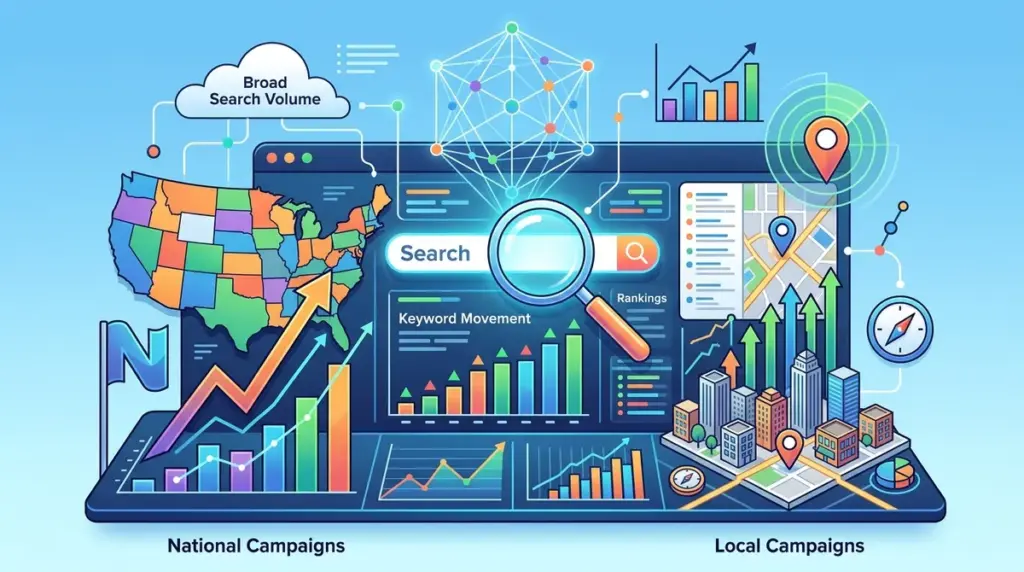
Tracking keyword performance requires a fundamental shift in methodology depending on whether your revenue is tied to a specific physical location or a broad digital market. A national campaign prioritizes market share and SERP feature dominance across an entire country, while a local campaign lives and dies by proximity, the Google Map Pack, and hyper-specific geographic intent. Misaligning your tracking strategy leads to "ghost data"—rankings that appear high in a general report but fail to drive foot traffic or conversions in the regions that actually matter to the business.
The Mechanics of National Keyword Tracking
National tracking focuses on high-volume, broad-intent head terms and long-tail informational queries. For a national brand, the goal is to displace competitors across a unified search landscape. Because the search results for a term like "enterprise CRM software" do not fluctuate significantly between New York and Los Angeles, the tracking setup can be centralized.
Primary Metrics: Share of Voice (SoV) and SERP Feature Ownership. In national campaigns, tracking whether you own the Featured Snippet or the "People Also Ask" box is often more valuable than a move from position 3 to position 2. These features provide the "pixel height" necessary to push competitors below the fold on a national scale.
Device Weighting: National campaigns often lean toward desktop tracking for B2B or complex SaaS products, though mobile remains a baseline. The strategy here is to monitor the "Average Position" across the entire country to identify broad algorithm shifts rather than localized anomalies.
Granular Precision in Local Keyword Tracking
Local SEO tracking is high-stakes because Google’s "Possum" filter and proximity algorithms change results based on a user’s exact GPS coordinates. Tracking "plumber" at a national level is useless; tracking "plumber" at a zip code or street-level radius is the only way to measure ROI.
The Map Pack vs. Organic Blue Links: Local tracking must distinguish between the Local Pack (the three-map listing) and localized organic results. A business might rank #1 in the Map Pack for "coffee shop" but #8 in the organic listings. If your tracking tool aggregates these into a single "average position," your reporting will be fundamentally flawed.
Best for: Multi-location franchises, medical practices, and legal firms where the "Near Me" intent drives 80% of click-through rates.
Warning: Avoid tracking local keywords using a broad "City" setting in high-density urban areas. Google’s proximity bias is now so tight that rankings can vary significantly from one city block to the next. For accurate data, use specific zip codes or exact latitudinal and longitudinal coordinates.
Key Technical Differences in Setup
When configuring your tracking environment, the following technical distinctions determine the utility of your data:
- Search Volume Accuracy: National campaigns use monthly search volume (MSV) as a primary filter. Local campaigns should ignore national MSV and focus on "Local Search Volume" to avoid chasing vanity terms that have no local demand.
- Ranking Frequency: National SERPs are relatively stable. Local SERPs are volatile and can change based on time of day (open/closed status) and mobile user movement. Local tracking often requires more frequent refreshes to capture these shifts.
- Competitor Sets: In national tracking, your competitors are other massive domains (e.g., Amazon, Forbes, G2). In local tracking, your competitors are often small, hyper-optimized local businesses or local landing pages of national brands (e.g., a specific Home Depot branch page).
The Role of Mobile vs. Desktop in Geographic Intent
For local campaigns, mobile tracking is the only metric that truly reflects user behavior. Most local searches occur on the go, often with "near me" or "open now" modifiers. If you are only tracking desktop rankings for a local business, you are missing the impact of the mobile-first index and the GPS-driven SERP.
National campaigns, conversely, must balance both. A national e-commerce site needs to know how it ranks on mobile for "best running shoes" (research phase) and on desktop (purchase phase). The tracking setup should segment these devices to see if mobile-specific technical issues, like slow Core Web Vitals, are dragging down national visibility.
Reporting for Stakeholders
When reporting national data, focus on "Market Share" and "Competitive Displacement." Show how your brand is winning larger slices of the total available search traffic. For local reporting, focus on "Local Pack Presence" and "Direction Requests." A local client cares less about an abstract ranking and more about how often their Google Business Profile appeared to a user within a 5-mile radius. A local client cares less about an abstract ranking and more about how often their Google Business Profile appeared to a user within a 5-mile radius, demonstrating how your Google Business Profile appears in local results.
Aligning Tracking with Revenue Models
To choose the right tracking depth, look at the conversion point. If the conversion happens via an on-site checkout regardless of the user's location, national tracking with a focus on SERP features is the priority. If the conversion happens via a phone call, a walk-in, or a localized service booking, you must invest in hyper-local tracking that mirrors the user's physical proximity.
Effective tracking is not about monitoring every keyword everywhere; it is about simulating the specific search environment of your most profitable customers. For national brands, that means broad visibility; for local brands, that means dominating the immediate vicinity.
Common Tracking Questions
Should I track keywords in every zip code my business serves?
No, this is usually cost-prohibitive and creates data noise. Instead, track "centroid" zip codes—the most competitive or highest-revenue areas—to use as a proxy for your overall local performance.
Does "Near Me" tracking work for national brands?
National brands can track "Near Me" queries if they have localized landing pages or physical storefronts. However, if you are a purely digital entity, you will rarely win these spots as Google prioritizes physical proximity for these specific intents.
How often should I change my tracked locations?
For national campaigns, locations rarely change unless you are expanding into new territories. For local campaigns, you should audit your tracking locations quarterly to ensure they align with your current Google Business Profile service areas and local competitor movements. For local campaigns, you should audit your tracking locations quarterly to ensure they align with your current Google Business Profile service areas and local competitor movements, making tracking your locations across multiple areas more effective.
Can I use national ranking data to predict local success?
Rarely. A site that ranks #1 nationally for "insurance" may not even appear in the top 10 for "insurance agent Chicago." Local search factors like reviews, local citations, and GBC optimization outweigh national domain authority in localized SERPs.